Brady Corbet & Mona Fastvold: The Architecture of Independence
Zero dollars upfront. Seven years to finance. Final cut retained. Three Oscars. $50M+ worldwide.
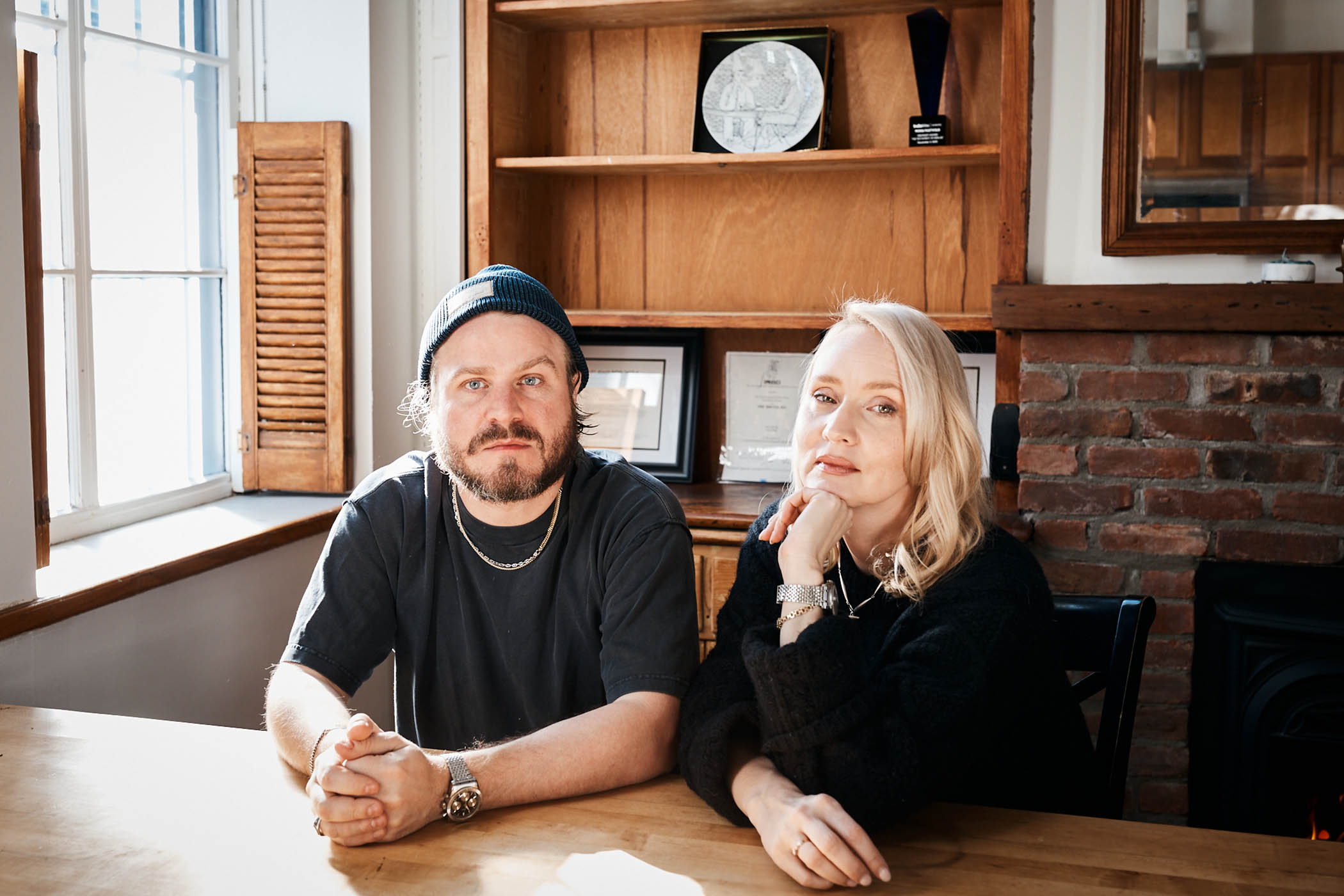
The Thesis: The Fee You Don't Take Is the Ownership You Retain
The Brutalist is a film about a visionary architect who makes impossible concessions to build what he sees in his head. A wealthy patron promises resources but demands control. The artist bends until he nearly breaks. The building gets built anyway — not because the patron was generous, but because the architect refused to stop. Brady Corbet and Mona Fastvold spent seven years trying to finance The Brutalist. A line producer told them they'd need $28 million to make it properly. They made it for under $10 million — roughly a third of that estimate — because anything more would have required surrendering final cut. They shot on VistaVision, a widescreen format unused since 1961. They insisted on a 15-minute intermission in a 3.5-hour film. They deferred their own pay.
Corbet told Marc Maron he made "zero dollars" on The Brutalist. And on Vox Lux before it. He supplemented income by directing Portuguese commercials.
Then The Brutalist won the Silver Lion at Venice, the BAFTA for Best Director, the Golden Globe for Best Director and Best Picture Drama, and earned 10 Academy Award nominations — winning three, including Best Actor for Adrien Brody. It has grossed over $50 million worldwide on a sub-$10 million budget. A24 paid an estimated $10–15 million for domestic rights alone. The film could clear $10–20 million in profit.
The allegory writes itself. The Brutalist is a film about what it costs to build something uncompromised — and the case study of its own creation is the same story.
This is the first creative partnership case in the library. And the purest expression of deferred compensation as ownership strategy: the fee you don't take upfront becomes the equity position you retain. The structures we read against Corbet and Fastvold's path — apprenticeship under masters, gross participation, constraint-based production, exclusive licensing — are our framework, not a deal-structure menu they worked from. They sacrificed the fee because the alternative was surrendering the film. The fit between what they did and how the structures behave is what makes the case useful.
Timeline

Financial Architecture: Zero Upfront, Everything on the Back End
| Element | Detail |
|---|---|
| Budget | Under $10M (with Hungarian/UK tax credits) |
| Corbet upfront fee | Deferred — "zero dollars" |
| Fastvold credit | Co-writer; Executive Producer |
| A24 domestic acquisition | Est. $10–15M (after Venice) |
| Focus Features international | Under $5M (pre-sold before production) |
| Worldwide gross | $50M+ |
| Estimated profit | $10–20M ("with some upside beyond that") |
| Back-end deal | Confirmed; includes nomination bonuses |
| Format | VistaVision 35mm (unused since 1961); 70mm in select theaters |
| Runtime | 3 hrs 35 min (including 15-min intermission) |
| Executive producers | 27 |
Career Budget Progression
| Film | Year | Budget | Gross | Director Pay | Result |
|---|---|---|---|---|---|
| The Childhood of a Leader | 2015 | ~$3M | Festival circuit | Minimal | Venice Best Director/Debut |
| Vox Lux | 2018 | ~$11M | $1.4M | "Zero dollars" | Critical divide; reassessment |
| The Brutalist | 2024 | <$10M | $50M+ | "Zero dollars" + back-end | 3 Oscars; $10–20M profit |
The Creative Partnership Model
This is the first creative partnership case in the library. The Corbet-Fastvold model is distinctive and structurally replicable.
Every screenplay in both filmographies is co-written. The Sleepwalker, The Childhood of a Leader, Vox Lux, The World to Come, The Brutalist, The Testament of Ann Lee — all co-written by Corbet and Fastvold. The writing is the foundation. It predates the romantic relationship. "We became friends right away. And then we started writing together."
Fastvold directed The Sleepwalker, The World to Come, and The Testament of Ann Lee. Corbet directed The Childhood of a Leader, Vox Lux, and The Brutalist. They co-directed The Crowded Room. The alternation means each builds a directorial identity while the other supports — and neither career is dependent on a single voice.
The Testament of Ann Lee was shot immediately after The Brutalist with the same crew in the same location. Daniel Blumberg composed the score for both The Brutalist and The World to Come. Shared infrastructure reduces costs and builds long-term creative relationships. Neither film could have been made as cheaply without the other.
When Corbet spent 22 months in UK post-production away from their daughter, the partnership absorbed the personal cost. When Fastvold needed to pivot from one project to the next in days, the shared crew and creative language made it possible. The partnership creates emotional and operational resilience that solo filmmakers can't access.
| Year | Film | Director | Key Notes |
|---|---|---|---|
| 2014 | The Sleepwalker | Fastvold | Sundance; Grand Jury Prize nom |
| 2015 | The Childhood of a Leader | Corbet | Venice: Best Director, Best Debut |
| 2018 | Vox Lux | Corbet | Natalie Portman; $1.4M gross |
| 2020 | The World to Come | Fastvold | Venice: Queer Lion |
| 2023 | The Crowded Room | Both (co-direct) | Apple TV+; 6 episodes |
| 2024 | The Brutalist | Corbet | 3 Oscars; $50M+ |
| 2025 | The Testament of Ann Lee | Fastvold | IFFR; Golden Globe nom |
The Compounding Effect
They co-write a script (always together). One directs while the other supports. Festival validation follows (Venice → BAFTA → Oscars). The back-end pays off (deferred fees become equity in the film's success). Success greenlights the next film — for both of them. Shared crew and infrastructure enable back-to-back production, reducing costs and building long-term creative relationships. And the cycle restarts with the next co-written script.
The partnership hub is the structural innovation. Everything that makes this flywheel distinctive — the alternating direction, the shared infrastructure, the back-to-back shooting, the emotional resilience through seven years of near-zero income — comes from the fact that it's two people, not one.
Transferable Lessons
Corbet didn't take acting roles for money or fame. He took them for education. Haneke teaches precision. Von Trier teaches risk. Assayas teaches rhythm. Östlund teaches provocation. When he quit acting in 2014, he'd studied under the greatest living European directors without paying tuition.
The application: If you're going to work for someone else, work for the best — and study how they work, not just what they produce. Your employment is an apprenticeship if you treat it as one.
Corbet made "zero dollars" upfront on Vox Lux AND The Brutalist. The trade: he retained final cut, chose VistaVision, insisted on the intermission, cast who he wanted. The back-end deal — deferred fee plus equity participation with nomination bonuses — turned poverty into an ownership position. On a $10–20M profit, the back end becomes real money.
The risk: Most films don't succeed. The deferred fee is a bet. If The Brutalist had flopped like Vox Lux ($1.4M gross), Corbet would have worked for free — again. This is the highest-stakes version of deferred compensation in the inventory.
The Corbet-Fastvold model: co-write everything, alternate directing, share crews, absorb each other's personal costs. The writing partnership predates the romantic relationship by years. The collaboration is formal and structural, not incidental. Neither The Brutalist nor The Testament of Ann Lee could have been made as cheaply or as well without the other.
The principle: Find someone whose taste you trust, whose skills complement yours, whose commitment matches yours. Then structure the collaboration. The partnership creates efficiencies and resilience that solo operators can't access.
Corbet's "back-of-the-cocktail-napkin math has gotten pretty good." He knows what VistaVision costs per foot. He knows daily crane rates. He knows what he can sacrifice and what he can't. Financial literacy enables creative freedom — because when someone says "we can't afford that," you can say "yes, we can, if we give up this."
The test: Can you price your own creative work from the line items up? If not, you're dependent on whoever does the budget to tell you what's possible. And they will always tell you to spend less on the thing that matters most to you.
Twenty years of acting provided an irreplaceable network. Access to Adrien Brody, Natalie Portman, Guy Pearce, Felicity Jones, Amanda Seyfried comes from decades of working alongside them. This network cannot be cold-started. Festival pedigree is self-reinforcing. Venice programmed Childhood of a Leader, which won, which meant Venice was receptive to The Brutalist. Extreme risk tolerance requires specific life circumstances. Making "zero dollars" on two consecutive films while supporting a family is survivable only under very specific conditions.
But the sequence transfers. Apprenticeship with masters → creative partnership → deferred compensation for creative control → back-end equity as ownership. This structural logic works whether the medium is film, music, publishing, or design. The scale is Corbet-Fastvold-specific. The architecture is universal.
Verification Info
Primary Sources
Secondary Sources
Verified Data Points
Gaps to Verify