Brandon Sanderson: The Hybrid Publishing Empire
Twelve unpublished novels. Then $41.7 million from 185,341 fans. He still publishes through Tor.

The Thesis: Don't Choose — Build Both
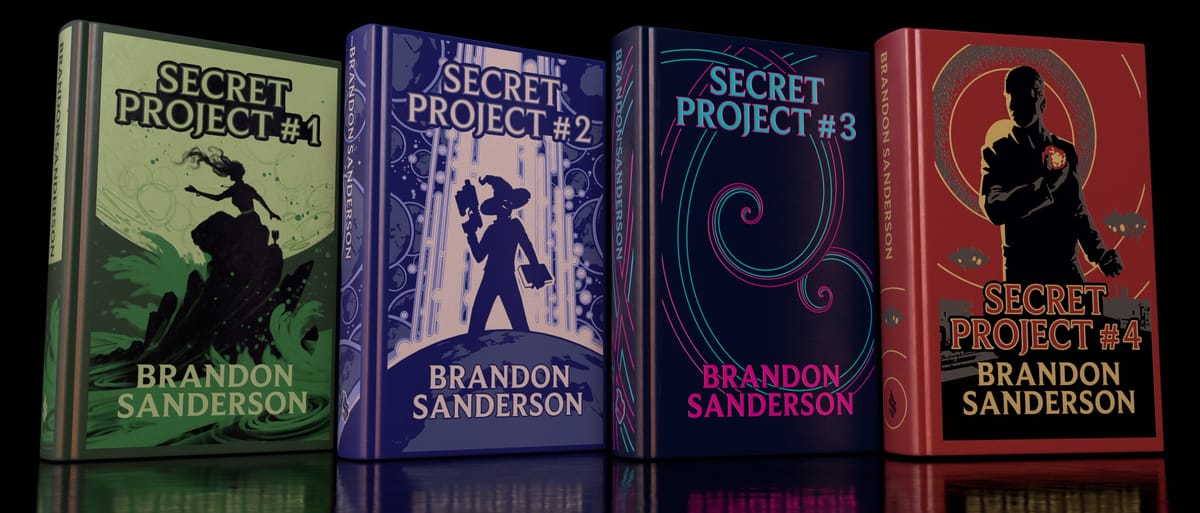
Brandon Sanderson wrote twelve novels before he published a single one — all while working the graveyard shift at a hotel. In 2022, he asked his fans for $1 million on Kickstarter to self-publish four secret novels he'd written during the pandemic. He hit $1 million in 35 minutes. $15.4 million in 24 hours — the single most successful day in Kickstarter history. He closed at $41,754,153 from 185,341 backers. Average pledge: $225. The most funded Kickstarter project in history. Two years later, a second campaign raised $15M+ in two days. He still publishes his major series through Tor Books.
The Kickstarter wasn't a stunt. It was a structural declaration. Sanderson and his wife Emily run Dragonsteel Entertainment — a company with 30+ employees, its own editorial team, art director, merchandising operation, online bookstore, annual convention (7,500 tickets sold out in one hour), and a planned headquarters complex. Sanderson uses a hybrid publishing model: his major series go through Tor for mass-market distribution, while Dragonsteel handles leatherbound editions, specialty books, audiobook distribution, merchandise, conventions, and all direct-to-fan sales.
Fans will pay dramatically more for creative work than intermediaries currently capture. The $225 average pledge against a $15–30 bookstore purchase is the premium gap — and it's approximately 10–15x.
The hybrid model is Sanderson's most transferable innovation. He didn't choose between traditional and independent publishing. He uses traditional for reach and discoverability. He uses his own infrastructure for premium margin and direct relationship. This resolves a false binary most creatives assume they must accept. The structures we read against the Sanderson arc — creator-as-platform, holding company, interconnected IP, diversified revenue — are our framework for naming what he and Emily built across two decades. Sanderson built what he wanted to write and a company that could keep selling it directly to the people who wanted to buy it; the fit between that and how the structures behave is what makes the case useful.
Timeline
Creator-as-Platform: The Hybrid Model
Sanderson's structural innovation is the hybrid model — he doesn't abandon traditional publishing. He uses it for mass-market distribution while building his own direct-to-fan infrastructure for premium products.
Dragonsteel Infrastructure
IP Architecture: The Cosmere as Compounding Asset
Sanderson didn't just write good novels — he engineered an interconnected universe that rewards deep engagement. The Cosmere spans 20+ novels across multiple series (Mistborn, Stormlight Archive, Warbreaker, Elantris) that share a deep mythology. Each new book adds value to every previous book because fans who discover connections want to read everything.
This is compound interest applied to IP. A standalone novel has a fixed audience. An interconnected universe has a compounding audience — every entry point feeds every other entry point.
The gap between what fans will pay directly ($225) and what authors receive through traditional channels (~$1.50 per paperback) is the financial expression of the discernment premium. Fans aren't paying $225 for four books. They're paying for Sanderson's judgment about what to write — which they trust more than any publisher's marketing department.
Revenue Architecture
| Stream | Type | Est. Annual Value | Trend |
|---|---|---|---|
| Kickstarter / D2F book sales | Direct sales | $15–41M (campaign yrs) / $2–5M baseline | Explosive |
| Traditional publishing (Tor) | Advances + royalties | $3–8M/yr | Strong |
| Leatherbound editions | D2F premium | $2–5M/yr | Growing |
| Dragonsteel Books (merch, apparel) | E-commerce | $1–3M/yr | Growing |
| Convention (Dragonsteel Nexus) | Events | $500K–$2M/yr | Growing |
| Audiobook revenue | Royalties / D2F | $1–3M/yr | Growing (post-Audible) |
The Compounding Effect
New books through Tor bring new fans who discover the interconnected Cosmere back catalog. New fans convert to the D2F relationship (newsletter, YouTube, State of the Sanderson). The direct relationship enables premium revenue — $225 Kickstarter pledges, $200 leatherbounds, convention tickets. Premium revenue funds Dragonsteel's growth (30+ employees, HQ complex, in-house editorial). Dragonsteel's scale creates industry leverage — Audible comes to negotiate. Leverage improves terms on the next Tor deal, which produces the next book that restarts the cycle.
The Creator-as-Platform (#12) infrastructure captures the premium gap. The Holding Company (#9) structure gives Dragonsteel institutional permanence beyond any single book. Catalog/IP Securitization (#14) — the Cosmere — ensures every new entry point compounds the value of the entire body of work. And Diversified Revenue (#10) across six channels makes the operation resilient to any single channel's volatility.
Transferable Lessons
Sanderson doesn't choose between traditional and independent publishing — he uses both. Tor provides bookstore distribution and mass-market reach. Dragonsteel captures premium margin on leatherbounds, merch, conventions, and direct sales. The hybrid model works because each channel serves a different purpose.
The application: Whatever intermediary distributes your work — gallery, publisher, label, platform — build a parallel direct relationship with your audience. Use the intermediary for reach. Use your own channel for margin. You don't have to choose.
Leatherbound editions, the Dragonsteel bookstore, YouTube announcements, annual "State of the Sanderson" updates, and the fan community (Coppermind wiki, 17th Shard) were all established before the $41.7M Kickstarter. The campaign worked because the infrastructure and relationship were already there. 185,341 people pledging $225 each requires years of trust-building.
The principle: D2F revenue requires direct relationship. Start building that relationship now — through email, through events, through transparency — before you need to monetize it.
The Cosmere is compound interest applied to fiction. An interconnected multiverse where each new book adds value to every previous book because fans discover connections and want to read everything. A standalone novel has a fixed audience. An interconnected universe has a compounding audience.
The pattern: Design your body of work for interconnection, not just as standalone pieces. A designer's case study portfolio that tells a cumulative story. A musician's catalog where albums reference each other. A consultant's framework where each new insight builds on previous ones. The architecture matters as much as the individual works.
Sanderson didn't negotiate with Audible from weakness. He publicly challenged their royalty structure (40% exclusive vs. 70% digital standard), then demonstrated an alternative by distributing audiobooks through Kickstarter. Audible came to the table in February 2024. Emily: "That's one thing we do have: direct contact with the fans."
The principle: Don't argue for better terms. Prove you can go around the intermediary. Then the intermediary negotiates. Demonstrated alternatives create leverage that pleading never does.
Brandon writes. Emily builds the business. Utah Business named both as "Leaders of the Year." This echoes Draplin/Coudal (Field Notes), Sultana/Lethbridge (Lonely Lands), and Rae/McKay (HOORAE). The pattern is consistent enough to name: creative vision paired with operational discipline. One without the other produces either unfulfilled talent or an empty machine.
The question: If you're the creative, who's your Emily? If you're the operator, who's your Brandon? The partnership is the structure.
Sanderson-level output. He writes multiple novels per year, consistently, at high quality. The 30-person infrastructure requires this output to sustain. If production slows, the overhead becomes a liability. The Wheel of Time assignment — being chosen to finish one of fantasy's most beloved series is a one-of-a-kind career accelerant. The $41.7M scale requires a massive, deeply engaged fanbase built over 15+ years. Most creators won't reach this threshold.
But the model scales down. You don't need 185,341 backers. Premium editions, direct sales, email lists, community events — these work at much smaller scale. A designer with 500 engaged clients can sell premium offerings at 10x the standard rate. The principle is universal; the scale is Sanderson-specific.
Verification Info
Primary Sources
Verified Data Points
Gaps to Verify