Timothy Goodman: Personal Brand as Multi-Category IP
40 Days of Dating (10M+ visitors). Uniqlo (1M units in 6 months). Nike KD15 (sold out in a week). Simon & Schuster memoir. A personal brand operating simultaneously across categories — design, footwear, books, public art.
The Thesis: The Personal Brand Is the Asset; the Categories Are Vehicles
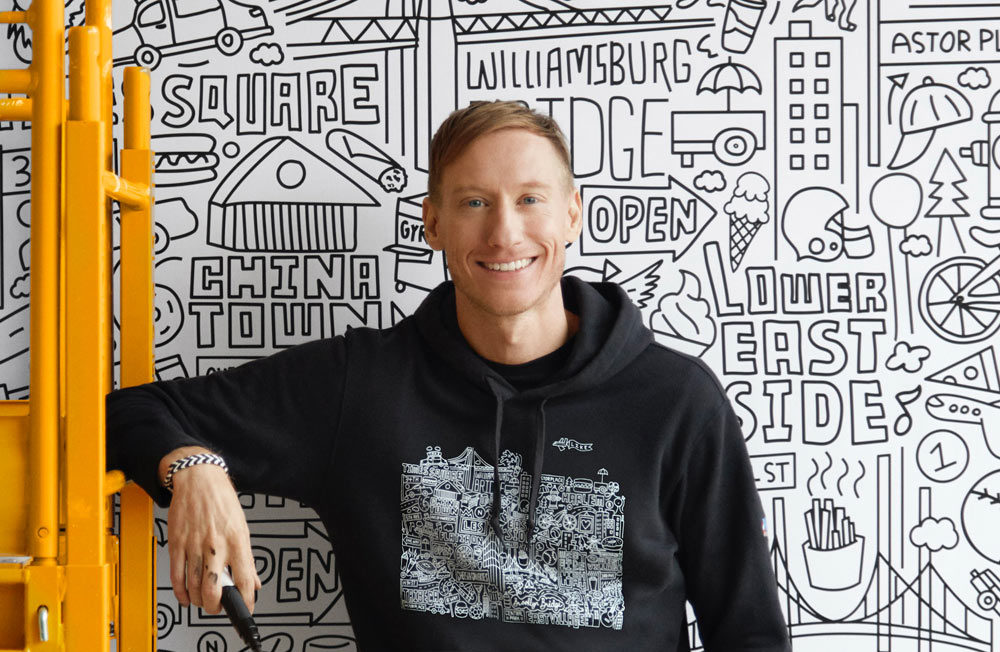
Most creative practitioners pick one vehicle and run it. The illustrator illustrates. The author writes. The muralist paints walls. The product collaborator does product collaborations. Goodman runs all of them in parallel, and crucially, he runs them under a single, recognizable visual and emotional identity — the high-contrast black-and-white hand-drawn lettering, the confessional tone about mental health and relationships, the aesthetic that one media outlet aptly described as "we are all descendants of Keith Haring."
The structural insight is that the personal brand itself is the asset, and the categories are vehicles. The Uniqlo collection sold 1 million units not because Uniqlo needed a t-shirt designer — it needed Timothy Goodman, recognizable to his social media following, recognizable to fashion press, and recognizable to the global Uniqlo collaborator lineage of Warhol, Basquiat, and Haring. The Nike KD15 sold out in a week not because Kevin Durant needed an industrial designer — Nike needed Timothy Goodman, the New York muralist whose work Durant had already commissioned for a Brooklyn community basketball court.
Every category Goodman enters, he enters as Timothy Goodman first and as a category practitioner second. The category does not define him; the personal brand does.
The catch is that the personal brand has to be specific enough to be recognizable. Goodman's brand is not a style; it is a worldview. The art is about love, heartbreak, mental health, masculinity, vulnerability, and the urban-romantic emotional register of New York City. Strip those themes out and the visual style would be pleasant but unremarkable. With them, the work is unmistakable. That specificity is what makes the personal brand portable across categories. The structures we read onto Goodman's career — product partnership, royalty structures, diversified revenue — are our framework, not a deal-structure menu he ran. The fit is what makes the case useful.
The Evolution
Five eras across roughly twenty-five years. Manual labor → corporate stack → viral founding event → solo studio confessionals → multi-vehicle product compounding.

Product Partnership: Uniqlo, Nike, and the Audience-Is-the-Asset Pattern
The Uniqlo and Nike collaborations are the cleanest examples in the In Sequence library of the Product Partnership Model: an artist and a brand co-developing a product, with the artist contributing creative IP and audience reach, and the brand contributing manufacturing, distribution, and marketing infrastructure.
The Anatomy of a Product Partnership Deal
Why Uniqlo Hired Goodman
Uniqlo's SPRZ NY program had previously partnered with Andy Warhol Foundation, Jean-Michel Basquiat estate, Keith Haring estate, and the Museum of Modern Art. Goodman was the first time the program partnered with a living independent artist of his career stage rather than a posthumous artist's estate.
Uniqlo needed Timothy Goodman — recognizable to his social media following, fashion press, and the SPRZ NY collaborator lineage. The audience was the asset. Uniqlo bought access to it.
As Goodman noted in interviews, large brands often see an independent artist's work, like the style, and then have their internal design teams produce a similar look. Nike could have done that. Instead, Durant instructed Nike to engage Goodman directly. The shoe is named the "Nike KD15 Timothy Goodman" — the artist's name is part of the product name.
Development took two years. Goodman mocked up over 150 colorway and typography variations. $150 retail. Sold out on Nike.com in approximately one week.
Most independent artists working with major brands either accept anonymity (work-for-hire, no name credit) or partial credit ("design by [studio]"). Goodman has consistently negotiated full name credit on every commercial deal.
Without it, the Uniqlo deal would have been a paycheck; with it, the Uniqlo deal is a credential that compounds into the Nike deal. The credit is what compounds. A brand that has decided your fee will not flex on the fee may flex on the credit.
Revenue Per Brand Partnership (Estimated)
Royalty Structures: Three Books, Compounding Catalog
Goodman's three books each operate under royalty structures. Sharpie Art Workshop (Quarry Books, 2015) and 40 Days of Dating: An Experiment (Abrams, 2015) are technique and project books. I Always Think It's Forever (Simon Element / Simon & Schuster, January 2023) is the most structurally important deal — acquired by a Big Five publisher imprint, with full author-illustrator credit, full royalty participation, and the marketing infrastructure of a major house.
The Memoir as Brand-Aligned IP
The graphic memoir chronicles a six-month period in Paris in 2019, during which Goodman fell in love with a Frenchwoman named Aimée and subsequently went through a heartbreak that catalyzed therapy, medication, and a diagnosis of attachment disorder partially rooted in childhood trauma.
The simultaneous release of the Nike shoe and the Simon & Schuster memoir is itself instructive. Most creators who land a major Nike collaboration would not also be releasing a Simon & Schuster memoir within the same six-week window.
Goodman did, because the personal brand operates simultaneously across categories rather than sequentially. The shoe is the brand commercial. The book is the brand emotional truth. Both fund and reinforce each other, and both extend the same Timothy Goodman identity.
The economics here are structurally similar to Loveis Wise's author-illustrated debut: the entire royalty pool flows to one creator, rights are concentrated, and the book functions as a fully-owned IP asset. Every additional book added to the catalog compounds the royalty stream.
Diversified Revenue Streams: The Eight-Layer Stack
Goodman's career is the canonical example of deliberate construction of multiple distinct revenue streams that protect against the volatility of any single one. The current revenue stack, as best as can be inferred from public sources, includes:
Why This Stack Took 13+ Years to Build
No single stream is overwhelmingly dominant. Each protects against the failure of others. If editorial illustration rates compress (they have), mural commissions can fill the gap. If brand budgets contract (they do, cyclically), book royalties continue paying. If a single Uniqlo-scale product partnership does not happen for several years, the cumulative smaller streams sustain the practice.
Goodman did not have eight revenue streams in 2013. He had a viral website. The streams accumulated over a decade as the personal brand expanded and as new categories opened up. The Creative Majority practitioner looking at Goodman's current stack should not try to reproduce all of it at once.
Start one stream, prove the audience is willing to follow you across formats, and then add the next stream when the first is producing reliably.
Five streams that each produce $5K a year are usually worse than one stream that produces $50K and a second that produces $20K. The goal is not raw stream count; it is the cumulative dollar value across reliable streams. Add a stream when the existing streams are stable enough that the new one is genuinely additive, not a distraction from the trunk.
The Compounding Effect: Cross-Category Compounding
The Goodman case is a study in cross-category compounding across four mechanisms.
Audience portability. 40 Days of Dating built an audience around an emotional vulnerability premise, and that audience followed Goodman into design (Uniqlo), footwear (Nike), publishing (Simon & Schuster), public art (Brooklyn courts and murals), gallery work, and education (SVA). Each new category did not require building a new audience — it required converting an existing audience to a new format.
Credential stacking across categories. A book jacket designer at Simon & Schuster who never publishes a book has credentials only in book design. A book jacket designer who later publishes a memoir at Simon & Schuster has credentials in both — and each credential reinforces the other.
Emotional-territory expansion. 40 Days of Dating (romance), 12 Kinds of Kindness (ethics), Friends with Secrets (mental health), I Always Think It's Forever (heartbreak, masculinity, attachment). The brand is not just visually consistent — it is emotionally cumulative. The integrated worldview is what every commercial partner is actually buying.
Community-infrastructure compounding. Pro bono murals, school donations, Kevin Durant Foundation court, SVA teaching, gallery shows benefiting not-for-profits. They build the community goodwill that makes future commercial deals easier and that protects the brand against the periodic backlash that any commercially successful artist faces.
Transferable Lessons
The goal is not to be the best illustrator, the best muralist, the best author, or the best brand collaborator. The goal is to build a recognizable personal brand that can be deployed across all of those categories simultaneously.
"Designer who does various commercial work" is not a brand; it is a job description. "Goodman the confessional black-and-white-lettering artist who writes about heartbreak and masculinity" is a brand. The temptation to vary the style for each commercial client is one of the most common career-limiting mistakes a creative makes.
40 Days of Dating is the founding event of Goodman's independent career. It was not a commercial project. It generated no service-work income. It produced one viral website, one book deal, two TV options, and an audience that all subsequent commercial work flowed from.
The first big personal project is not optional for a creator who wants to build a personal-brand career. It does not have to be viral. It has to demonstrate, on a public platform under your own name, the worldview and the visual identity that the rest of the career will be built on.
Uniqlo did not partner with Goodman because his work was beautiful. Uniqlo partnered with Goodman because his audience was an audience Uniqlo wanted access to.
Think about audience-building as a primary career investment, not a marketing afterthought. A 50,000-follower Instagram account that is genuinely engaged is, structurally, a more valuable career asset than a portfolio of beautiful work seen by no one.
The eight-stream revenue stack Goodman runs in 2026 did not exist in 2013. It was added one stream at a time over a thirteen-year period. Each new stream took a year or two to establish.
The trap to avoid is stream proliferation without depth. Five streams that each produce $5K a year are usually worse than one stream that produces $50K and a second that produces $20K.
Pro bono murals, school donations, the Brooklyn court for Kevin Durant Foundation, SVA teaching, gallery shows benefiting not-for-profits — all of these are structurally adjacent to Goodman's commercial career but not directly compensated.
They function as brand insurance. Every commercially successful artist eventually faces some kind of backlash. The artists who survive are the ones with documented community contributions that cannot be erased. The benefit is real, but it is only visible in the moment of crisis — and by then, it is too late to start building it.
The 2013 40 Days of Dating viral moment. A two-person dating experiment racking up 10M+ unique visitors via Today Show / Warner Bros / Netflix optioning rode an internet content era that no longer routes attention the same way; the founding event is window-specific. The Apple → Brian Collins → Simon & Schuster credentialing stack. Three Stage 2 institutional roles in succession by age 30 is a credential ladder most independents do not access. The Kevin Durant routing into Nike. The KD15 happened because Durant personally instructed Nike to engage Goodman directly after the PS 315 Brooklyn court — that kind of athlete-as-patron pathway into a signature shoe is not engineerable on a project timeline. The first-ever-living-artist Uniqlo SPRZ NY slot. Joining a lineage that previously partnered only with the Warhol / Basquiat / Haring estates is a tier of cultural placement most designers will never receive even once.
But the personal-brand-as-asset logic is universal. Treat the brand, not the discipline, as the trunk: name credit on every commercial deal — even when the brand will not flex on the fee — because the credit is what compounds into the next deal. Make the first big personal project under your own name on your own platform; it does not have to go viral, it has to demonstrate the worldview and visual identity the rest of the career will be built on. Add revenue streams sequentially, not all at once — five streams at $5K each are usually worse than one at $50K plus one at $20K. And build community infrastructure (pro bono work, teaching, donated commissions) deliberately as brand insurance, not as marketing. These principles work whether the audience is 2M followers or 20K.
Primary Sources
Verification Info
Verified Data Points
Gaps to Verify