Johnny Harris: 143 Million Views He Didn't Own — Then He Rebuilt the Whole Thing
143M views for Vox (owned nothing). 6.6M subscribers for himself. NewPress: 4 channels, 30+ employees.

The Thesis: Rebuild the Institution You Outgrew — Under Your Own Name
Johnny Harris bought his first decent camera — a Canon 7D — by donating plasma with his girlfriend. Both arms, $45 each, once a week. They paid off the credit card and taught themselves to shoot. A decade later, Harris runs a media company with 30+ employees, $100,000 per month in overhead, and 6.6 million YouTube subscribers. He makes millions per year from AdSense alone. His company, NewPress, operates four creator-led journalism channels with 10 million combined subscribers and is expanding toward eight. He won an Emmy for a New York Times Opinion video. And every bit of it traces back to a single moment: proposing a solo trip to Cuba to his bosses at Vox, who approved it but could not give him a crew.
He went alone, for under $2,000. That trip became Borders — the series that would be nominated for two Emmys, accumulate 143 million views, and teach Harris everything he needed to build what came next. None of those 143 million views belonged to him. Vox owned every frame.
NewPress is structurally similar to Vox: a network of visually-driven explainer channels with shared production infrastructure. The difference is that Harris and Iz own it. They rebuilt what they left — but as founders, not employees. Same model, inverted ownership.
For the library, Harris is the institutional-employee-to-media-company case — the purest example of studying how an institution works, then rebuilding it under your own name. Every creative professional who has built value for an employer and wonders "what if I owned this?" is looking at their version of the Vox-to-YouTube transition. The structures we read onto Harris's career — premium service, product, platform, holding company — are the In Sequence library's framework, not Harris's. He bought a camera by donating plasma, learned visual storytelling at Vox over six years, started a personal channel two years before Borders was cancelled, and built NewPress because the model he had learned worked better with ownership inverted. The fit between what he built and how the structures behave is what makes the case useful.
Timeline
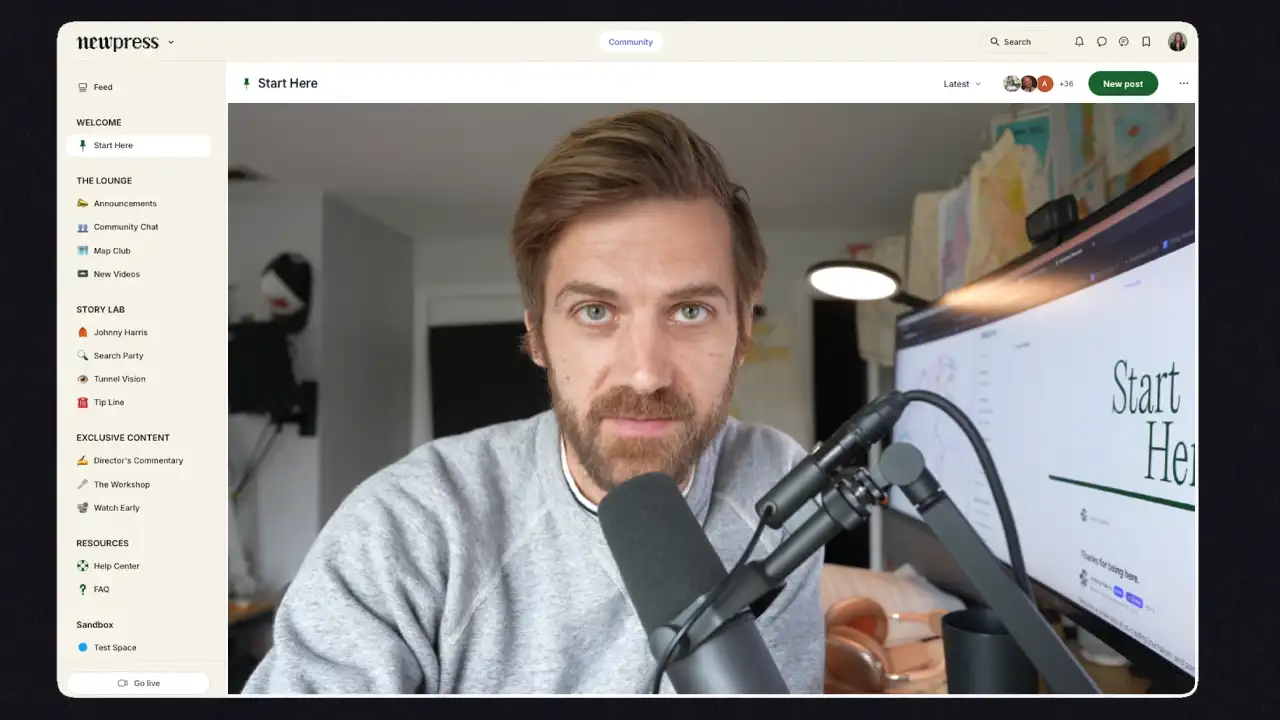
NewPress: The Vox Model, Ownership Inverted
| Channel | Creator | Focus | Subscribers |
|---|---|---|---|
| Johnny Harris | Johnny Harris | Global systems, geopolitics, history | 6.6M+ |
| Search Party | Sam Ellis | Geopolitics, sports, unexpected connections | 710K+ |
| Tunnel Vision | Christophe Haubursin | Internet mysteries, OSINT investigations | Growing |
| The Bigger Picture | Max Fisher | Human behavior, global systems | Growing |
The WEF Problem: Journalism vs. Sponsorship
In 2021, Harris produced a video called "How China Became So Powerful" that was sponsored by and co-written with the World Economic Forum. The sponsorship disclosure came only at the end. The video was indistinguishable from his regular journalism. A version of the script appeared on the WEF website with their head of media listed as first author. The "Contains Paid Promotion" YouTube banner was not used.
This is not a personal failing — it is a structural tension every independent creator-journalist faces. When revenue comes from sponsorships and AdSense, the line between journalism and promotional content becomes the ethical fault line. Institutions like the NYT or Vox have (imperfect) firewalls between editorial and advertising. Independent creators have to build those firewalls themselves, and the financial incentives push against it.
The membership model — funded directly by audience rather than sponsors — is partly an attempt to solve this problem. Direct audience support aligns incentives: the audience pays for trustworthy journalism, not for promotional content disguised as journalism. Whether this model can fully replace sponsorship revenue at the scale NewPress requires remains to be seen.
The Compounding Effect
Learn the model at the institution (Vox: 143M views, Emmy nominations). Build personal channel while employed (launched 2018, two years before Borders cancelled). Go independent when ready (6.6M subscribers). Build the infrastructure for others (30+ employees, $100K/month overhead). Recruit from the institution that trained you (Vox alumni pipeline). Network compounds (10M+ combined across 4 channels, target 8). And the model continues — same structure as Vox, ownership inverted.
The hub is "Same Model, You Own It" because the flywheel's engine is literally rebuilding an employer's successful model under personal ownership. Study how it works, then build your own version.
Transferable Lessons
Harris launched his personal YouTube channel in 2018, two years before Borders was cancelled. When the institutional floor disappeared in 2020, he already had an audience, a format, and operational knowledge. The personal channel was not a backup plan — it was the primary plan. The time to build your own platform is while you still have a paycheck.
Study how your employer's system works — the production process, the audience strategy, the revenue model, the team structure. Then rebuild it under your own ownership. NewPress is Vox rebuilt with ownership. Harris didn't invent a new model. He took the one that trained him and inverted the ownership structure.
Harris's wife Iz started hiring with 10,000 subscribers. Harris, the journalist-auteur, did everything himself. Her instinct was right. The creator who insists on doing everything themselves stays a freelancer. The one who delegates becomes a founder. Management, hiring, finances, and delegation are skills most journalists do not possess — and they are the skills that enable the creator-to-CEO transition.
If you claim journalistic credibility, your audience-trust model cannot tolerate undisclosed sponsorship. The WEF controversy proved this. Membership and subscription models align incentives better than advertising. The audience pays for trustworthy journalism, not for promotional content dressed as editorial.
The Vox training ground. Six years learning visual storytelling at one of the most innovative digital media companies of its era. The Iz factor. A co-founder and spouse who is simultaneously a successful creator and natural operator — rare structural advantage. Pandemic timing. Borders cancellation coincided with a period when YouTube viewership surged globally.
But the rebuild-with-ownership model transfers completely. Build your personal channel while employed. Study your employer's model. Hire early. Build ethical firewalls. Recruit from the talent pool your institution trained but didn't retain.
Verification Info
Primary Sources
Verified Data Points
Gaps to Verify